
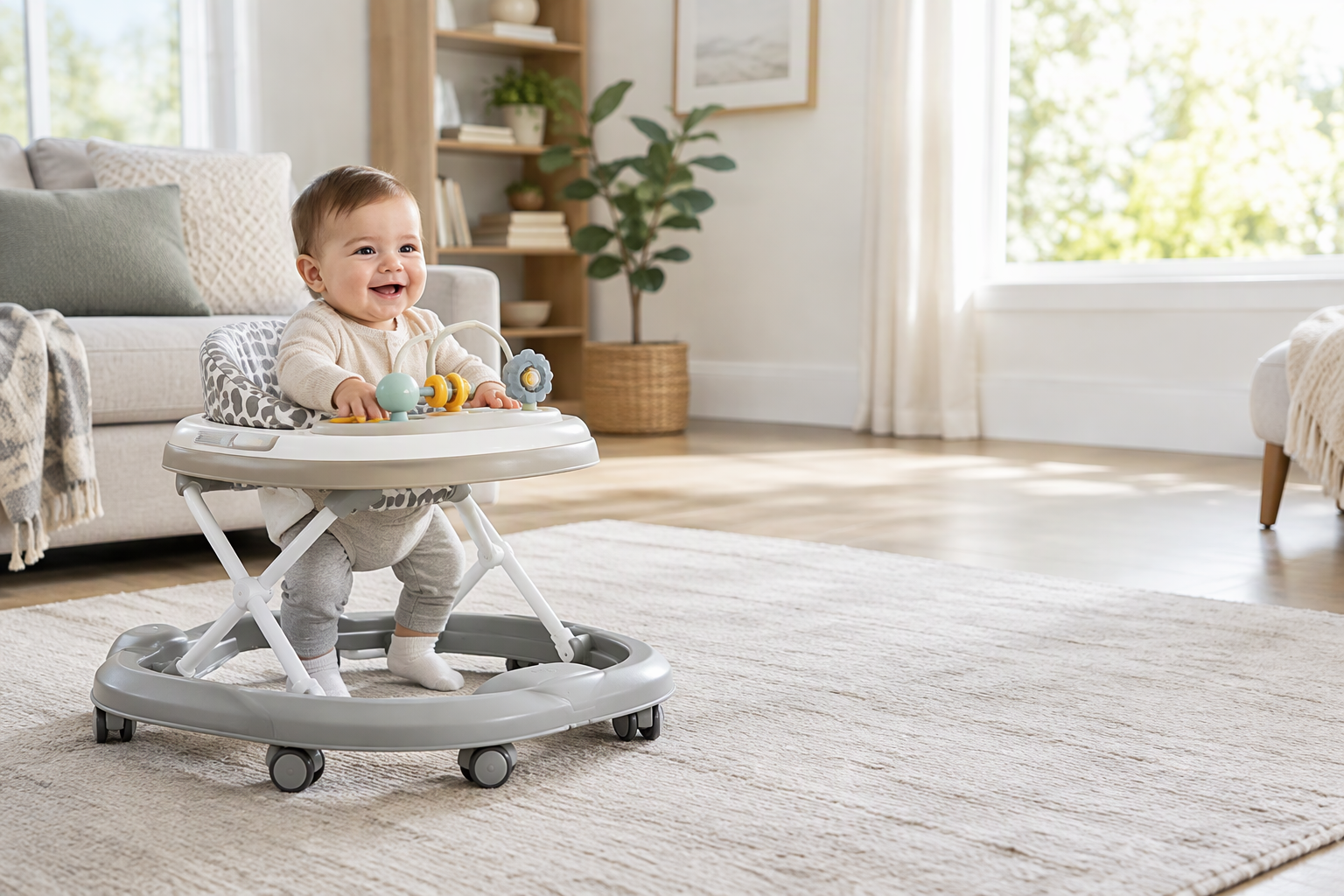
Learning how to choose a baby walker takes more thought than comparing colors and toy features. A walker affects how a baby moves around the home, how easily a parent can supervise, and how well the product fits the child’s body and the family’s daily routine. The safest buying decision starts with realistic expectations: a baby walker is an optional convenience product for short, supervised play, not a replacement for floor time, crawling, pulling up, or learning to walk naturally.
In this detailed guide, you will learn what to check before buying, how to evaluate fit and stability, which features are genuinely useful, what problems to avoid, and how to create a safer space when your baby uses a walker.
Quick answer: how do you choose a baby walker?
Choose a baby walker that fits your child’s height and weight, has a broad and stable base, rolls predictably on your floors, includes a secure seat, and can be cleaned easily. Adjustable height is useful, but the lowest setting should still let your baby place the feet comfortably on the floor without standing on tiptoes. Look for smooth edges, secure fasteners, a well-protected battery compartment, and no loose small parts.
Before buying, measure your doorways and the spaces where the walker will be used. Check the folded size if storage matters. Most importantly, plan to use the walker only on a clear, flat floor while an attentive adult is nearby. Keep it far from stairs, balconies, hot surfaces, open doors, cords, pools, heaters, and unstable furniture.
Is a baby walker necessary?
No baby needs a walker in order to learn to stand or walk. Babies build strength and coordination through supervised tummy time, rolling, sitting, crawling, reaching, pulling up, cruising along furniture, and playing on the floor. A walker may provide a change of position and an entertaining activity area, but it should not replace those opportunities.
Some parents choose a walker because it gives their baby a different way to play while the parent remains close. Others prefer a stationary activity center, floor seat, push toy, or activity table. The right choice depends on your home, your baby’s development, and your ability to supervise. If a healthcare professional has raised concerns about posture, muscle tone, hip development, or movement, ask for guidance before purchasing one.
1. Start with your baby’s age, height, and weight
Age ranges on packaging are only a starting point. Babies of the same age can have different heights, body proportions, and levels of coordination. Use the manufacturer’s minimum and maximum weight and height guidance as the main filter.
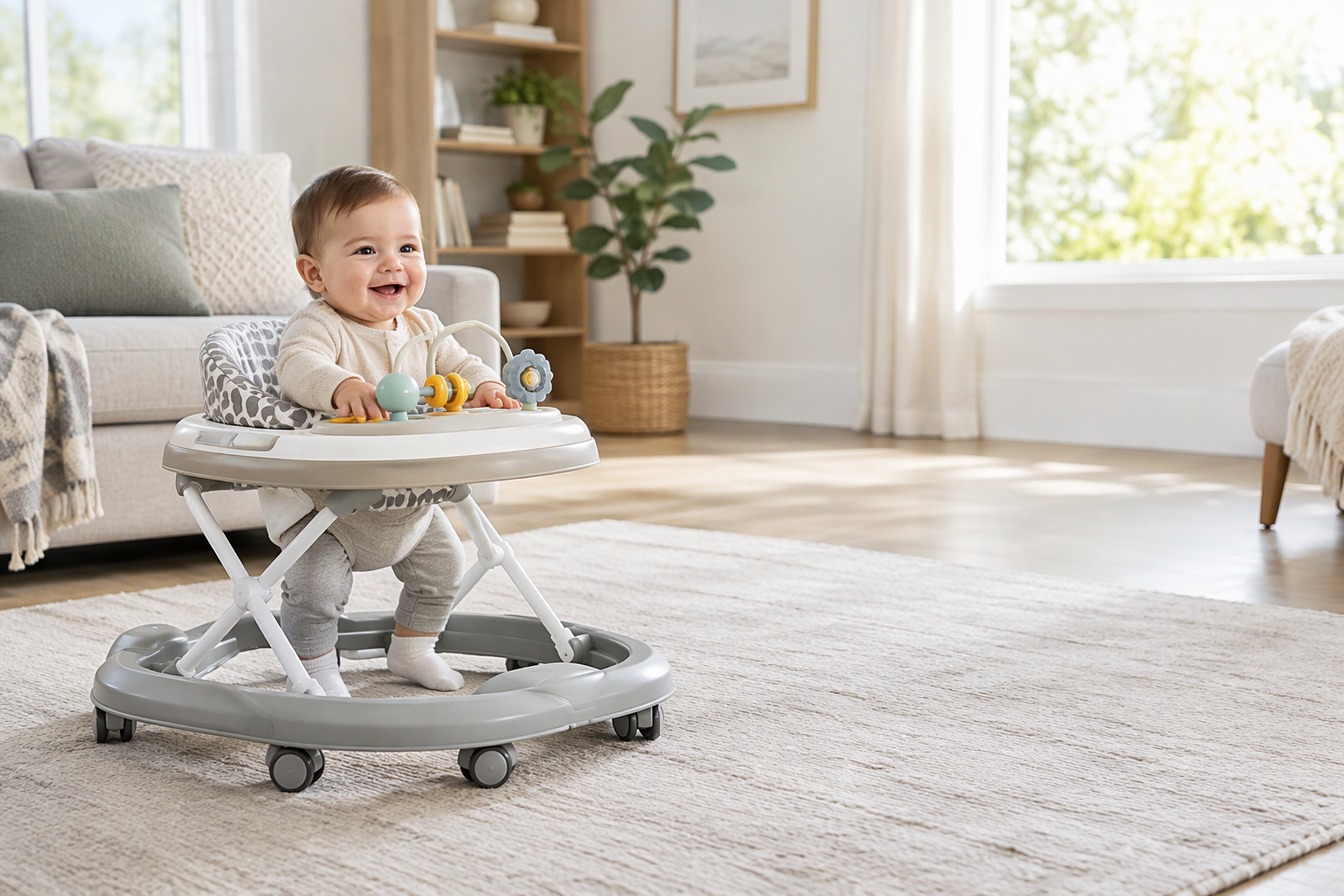
Your baby should sit comfortably in the seat with the back supported. The feet should touch the floor with the knees slightly bent. If only the toes touch, the walker may encourage awkward movement and make it harder for the baby to stop. If the seat is too low, the baby may lean forward, drag the frame, or place too much pressure through the legs.
Adjustable height settings can extend the useful life of a walker, but adjustment mechanisms must lock securely. Test every position before placing your baby inside. If the frame shifts, folds, or drops when you apply gentle pressure, do not use it.
2. Choose a wide and stable base
The base is one of the most important parts of a walker. A broad footprint gives the product more resistance against tipping when a baby reaches for a toy or turns quickly. A narrow base may fit through doors more easily, but it can be less stable if the child leans to one side.
Look at the walker from the front, side, and underside. The frame should sit level on a flat floor, and the wheels should be positioned evenly. Avoid bases that flex significantly when you press down on one corner. Check whether the edges are smooth and whether the base can catch on rugs, thresholds, or furniture legs.
A wide base does not make stairs safe. It can still roll toward an edge or allow a baby to reach objects that were previously out of range. Safety depends on supervision and a controlled environment, not on the base alone.
3. Evaluate wheel speed and movement
Wheel design changes the way a walker behaves. Swivel wheels make turning easier, while larger wheels may roll more smoothly over low-pile rugs. Hard plastic wheels can move quickly on tile, polished stone, and wood. Rubberized wheels may offer more grip, but they can still move rapidly on smooth surfaces.
Try the walker on the floor types in your home. It should roll without wobbling, dragging, or suddenly changing direction. If you have rugs, check whether the front wheels climb onto them without catching. A wheel that stops suddenly can cause the baby to lurch forward.
Some models include wheel locks, friction strips, or non-skid pads. These may slow movement during stationary play, but they should not be treated as a complete safety system. Read the instructions to understand when those features can be used and inspect them regularly for wear.
4. Check the seat design and leg openings
The seat supports your baby for much of the time spent in the walker. Look for a padded backrest, comfortable leg openings, and fabric that does not rub against the thighs. The seat should hold the baby upright without squeezing the body or allowing excessive leaning.
Removable, washable fabric is especially useful. Babies spill milk, drool, eat snacks, and sometimes have diaper leaks while playing. A seat that can be removed without complicated tools is easier to keep hygienic.
Inspect the stitching, attachment points, and seams. There should be no loose threads, sharp edges, exposed screws, or gaps where fingers can become trapped. If the seat insert is removable, confirm that it locks firmly into the frame and cannot be pulled out easily.
5. Decide whether an activity tray is useful
Many walkers include activity trays with buttons, lights, sounds, mirrors, spinners, rattles, and textured surfaces. These features can encourage reaching, grasping, pressing, and cause-and-effect learning. They can also make short periods of supervised play more interesting.
Do not assume that a tray with more toys is automatically better. Too many lights and sounds may overstimulate some babies, and loud electronic features can become irritating in a small room. Choose a tray with simple, age-appropriate activities that can be wiped clean.
A removable tray is versatile because the walker can become a quieter table for snacks or toys. Check that removable toys are large enough not to become choking hazards and that battery covers use a secure screw or child-resistant closure.
6. Consider cleaning and hygiene
Baby products need frequent cleaning, so maintenance should influence your choice. Smooth plastic is usually easier to wipe than deeply textured surfaces with narrow grooves. A seat with removable fabric is easier to wash than a fixed cushion.
Ask how the manufacturer recommends cleaning the wheels, frame, tray, and seat. Avoid harsh chemicals unless the instructions permit them. Check the wheel axles for hair, crumbs, and dust because buildup can affect movement.
Make cleaning part of your routine. Wipe high-touch areas often, wash removable fabric as directed, and allow parts to dry completely before reassembly. Never use a walker with damp fabric, cracked plastic, or a loose seat attachment.
7. Compare folding and storage features
If your home is small, a folding walker may be attractive. Measure the folded height and width, then compare those measurements with your cupboard, storage shelf, or car boot. Remember that the walker also needs enough open space when your baby uses it.
Examine the folding mechanism. It should be obvious how the frame opens and locks. Avoid designs that pinch fingers or require excessive force. After opening the walker, gently move the frame from side to side and confirm that the locking points stay secure.
A walker that folds is not automatically safer or stronger. Construction quality, locking reliability, and correct assembly matter more than compact storage.
8. Match the walker to your floors and home layout
The same product may behave differently on tile, wood, carpet, rugs, and uneven thresholds. Smooth floors can make a walker move quickly. Thick carpet can slow it down and encourage the baby to push harder. Door strips can catch small wheels.
Before the first use, create a clear play zone. Remove loose cords, floor lamps, pet bowls, small furniture, tablecloths, unstable decorations, and objects that can be pulled down. Keep hot drinks, cooking equipment, medicines, cleaning products, and sharp items completely out of reach.
Use safety gates around stairs and other restricted areas, but never assume the walker itself will stop at a gate or edge. The safest arrangement is a flat, enclosed, supervised area without steps or raised surfaces.
9. Look at construction quality
A good walker should feel solid without being unnecessarily heavy. The frame should remain level, the tray should not twist, and the seat should attach evenly on all sides. Plastic should be smooth and free from cracks, sharp flash, or strong chemical odor.
Read the assembly instructions before buying if they are available. Complicated assembly increases the chance that a part will be missed or installed incorrectly. Keep the instructions and check whether replacement wheels, seat covers, batteries, or fasteners are available.
Review the warranty and return policy. A warranty does not replace careful inspection, but it may indicate that the manufacturer has a process for defective parts. Stop using a walker immediately if the frame bends, a wheel loosens, a lock fails, or a part breaks.
10. Check safety features without overestimating them
Some walkers include anti-slip pads, wheel locks, speed-control designs, or stair-resistant features. These can be useful, but marketing language should not replace practical testing and supervision.
Ask what each feature actually does. A friction pad may reduce movement but not stop it. A stair-resistant design may not work on every edge or surface. A wheel lock may secure the product for stationary play but may not hold on a slope.
Safety features work best when combined with correct setup, a clear floor, and a nearby adult. No consumer walker should be treated as a device that allows a baby to move around the home unattended.
11. Use customer reviews carefully
Reviews can reveal problems that product photographs do not show. Look for repeated comments about wheel speed, noisy toys, difficult cleaning, weak seat attachments, unstable trays, or poor performance on carpet.
Give more weight to detailed reviews that explain the baby’s height, the home’s flooring, how long the product was used, and whether the problem appeared immediately or after several weeks. Short comments such as “cute” or “perfect” do not tell you much about safety or durability.
Read recent reviews as well as older ones because manufacturers may change materials, colors, packaging, or included features. If several buyers mention the same broken component, treat that pattern as important.
12. Consider noise and stimulation
Electronic toys can make a walker more engaging, but sound levels matter. A loud tray may disturb sleep, overwhelm a sensitive baby, or make it difficult for a parent to hear other sounds in the room.
Look for adjustable volume or a silent mode. Choose a tray that offers tactile and visual play rather than relying entirely on music and lights. The best feature is one that encourages active interaction without making the walker impossible to use in a calm family space.
13. Think about longevity and value
A walker may be used for a relatively short stage, so calculate value realistically. Adjustable height, a removable tray, washable materials, and a durable frame can extend usefulness. However, a long feature list is not valuable if the seat is uncomfortable or the product is difficult to clean.
Compare the complete ownership cost, including delivery, batteries, replacement parts, accessories, and possible repairs. A simple, sturdy walker may be better value than a cheaper model that needs replacement parts quickly.
14. Inspect the product immediately after delivery
When the walker arrives, inspect every component before assembly. Check the box for crushed corners or water damage, then compare the parts with the instruction list. Look for cracks, missing screws, damaged wheels, loose stitching, and incomplete labels.
Assemble the walker on a clean floor where small parts cannot disappear. Follow the instructions in order and do not substitute screws or use improvised repairs. Test the height locks, seat, tray, and wheels before placing your baby inside.
15. Make a safe-use routine
Use the walker only when you are alert and close enough to intervene. Keep sessions short and observe how your baby sits, moves, turns, and reacts. Stop if the baby appears uncomfortable, leans heavily to one side, becomes frustrated, or tries to climb out.
Never use a walker near stairs, open doors, balconies, pools, heaters, fireplaces, ovens, hot drinks, cords, tablecloths, or shelves with breakable objects. Do not place the walker on a table, bed, sofa, ramp, or raised platform.
Inspect the product before each use. Check the seat attachment, wheel movement, tray, locks, and frame. Do not continue using it after the baby exceeds the weight or height limit or can climb out.
Baby walker safety checklist
- Confirm that the product fits your baby’s height and weight.
- Make sure both feet reach the floor comfortably.
- Check that the seat, tray, and height locks are secure.
- Use the walker only on a clear, level floor.
- Keep the walker away from stairs, edges, heat, water, and cords.
- Keep batteries and small detachable toys secured.
- Stay close and watch your baby continuously.
- Clean the seat and tray regularly.
- Inspect wheels, seams, locks, and frame for damage.
- Stop use when the baby can climb out or exceeds the product limits.
Baby walker alternatives
A stationary activity center can offer toys and sensory play without allowing the baby to roll across the room. This may suit families who want a defined play area or have many hazards that are difficult to remove.
A floor activity mat supports rolling, reaching, tummy time, and early movement. It is simple, portable, and useful even after the baby begins crawling. A low activity table can be helpful later, when the child can stand with support and interact while remaining in a controlled area.
A push toy may be suitable when a child can stand, balance, and walk with support. It should be used on a clear surface with an adult nearby because a fast-rolling push toy can move away from the child unexpectedly.
Frequently asked questions
What age is best for a baby walker?
There is no single best age for every child. Follow the product’s stated minimum age, height, and weight, and use the walker only when your baby can sit upright with good head and trunk control. Ask a healthcare professional if you are unsure whether your baby is ready.
Should a baby’s feet be flat in a walker?
The fit should allow the feet to make comfortable contact with the floor while the knees remain slightly bent. If your baby is standing on tiptoes or cannot reach the floor, adjust the height or stop using the product until the fit is correct.
Are activity walkers safe?
An activity walker can be used for short, supervised play when it is correctly assembled and placed in a safe area. Activity toys do not eliminate the need for supervision, and no walker should be used near stairs, heat, water, or other household hazards.
How long should a baby stay in a walker?
Follow the manufacturer’s guidance and keep use limited rather than making the walker the main place your baby plays. Balance walker time with floor play, reaching, rolling, crawling, and supported standing.
What is better than a baby walker?
There is no universal answer. A floor mat, stationary activity center, low activity table, or push toy may be a better fit depending on your baby’s stage and your home. The best product is the one that supports safe, supervised play without restricting important movement experiences.
Final buying advice
When learning how to choose a baby walker, focus on fit, stability, predictable movement, comfort, cleaning, and safe use. Do not buy based only on bright colors, electronic toys, or a low price. Measure your home, read the weight and height limits, inspect the base and wheels, and think about how the product will fit into your daily routine.
A baby walker should be a small part of a balanced play routine. The right choice is a product that fits your baby today, remains stable on your floors, is easy to maintain, and can be used responsibly with an attentive adult nearby.
Parenting note: This article provides general buying information. Always follow the manufacturer’s instructions and seek qualified medical advice for concerns about your child’s development, posture, movement, or safety.

Leave a Reply